Energy certificate
Homes and commercial premises: surveyed on site, calculated, and filed on the regional register.
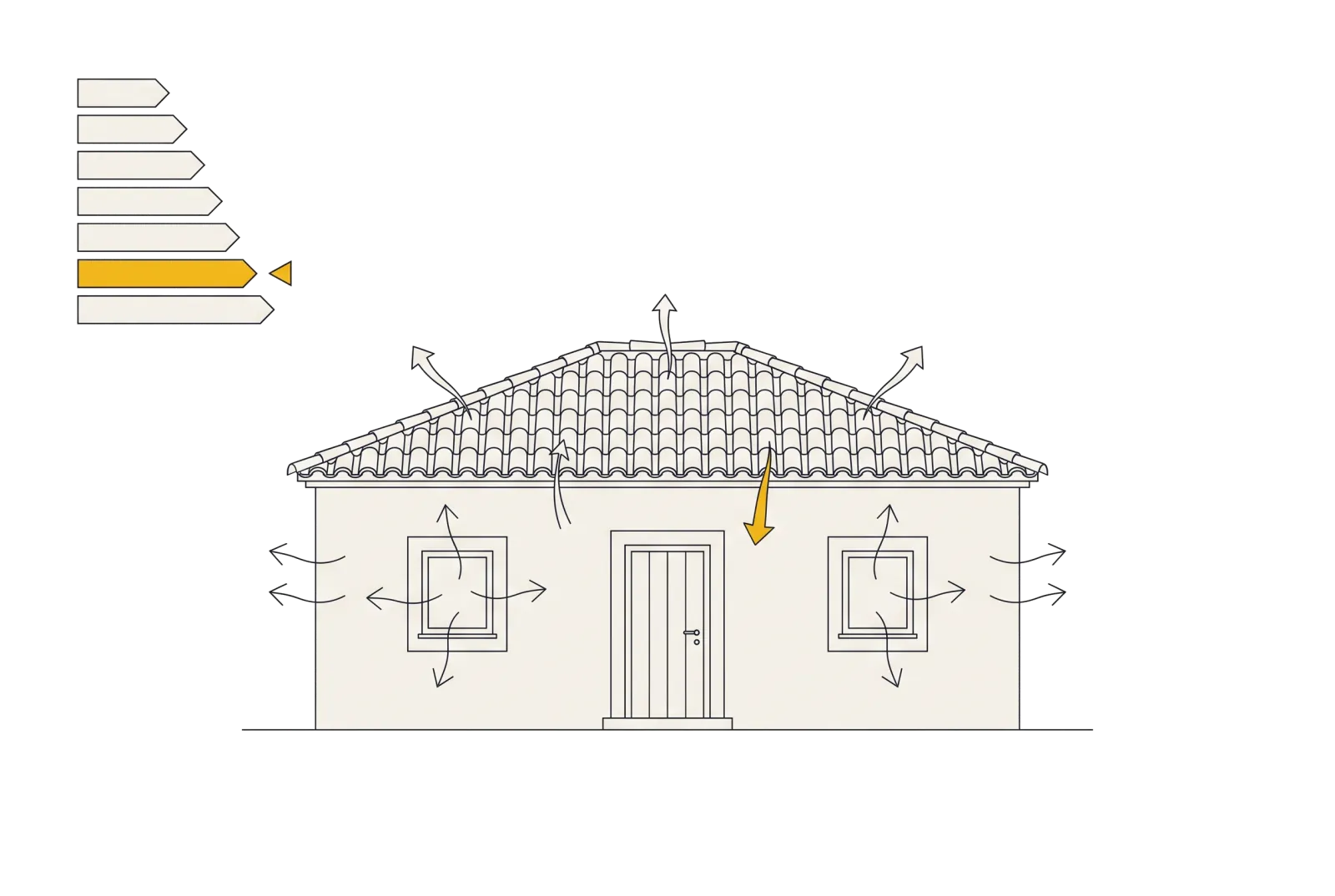
The energy efficiency certificate quantifies the energy a property needs to run under normal conditions — heating, cooling, ventilation and hot water, and lighting too where the use is not private residential — and the CO₂ emissions that go with it. The result is two indicators, kWh/m²·year of non-renewable primary energy and kgCO₂/m²·year, and the letter from A to G that sums them up on the label. It is the Spanish counterpart of the certificate your own country asks for when a property changes hands.
It is not an estimate. The calculation follows the official procedure and runs on data gathered at the property: the building envelope — walls, roof, floors, openings and thermal bridges — the orientation and what shades it, and the systems installed.
It is asked for by the notary before a sale is signed, by the agency or the portal before a listing goes up, by the administration when the property is going into tourist use, and by the building evaluation report when one is under way, among others.
What you call it at home
Most of Europe issues this certificate under the same European directive, so you have almost certainly met it already under another name:
- United Kingdom — Energy Performance Certificate, the EPC.
- Belgium — EPC in Flanders, PEB in Brussels and Wallonia.
- Netherlands — energielabel.
- Germany — Energieausweis.
- France — diagnostic de performance énergétique, the DPE.
- Italy — attestato di prestazione energetica, the APE.
- Denmark — energimærke.
- Norway — energiattest, from the energimerking.
- Sweden — energideklaration.
- Poland — świadectwo charakterystyki energetycznej.
- Switzerland — the GEAK, CECB in French. Outside the directive and voluntary in most cantons, but the same idea and the same A to G.
Two countries our clients often come from have nothing that matches. The United States has no national certificate at all: the ratings that exist — the HERS Index, the Home Energy Score — are voluntary and attach mostly to new build. In Russia the energy passport belongs to the block rather than to the flat, and it is not something a seller hands a buyer.
Where an equivalent does exist, it is not interchangeable with this one. Each is issued under its own country's rules and registered there, so a property in Spain needs the Spanish certificate however recent the one you hold at home.
Homes and commercial premises
We certify both uses and every variant of them: flats, detached houses, whole buildings, shop units and offices. What changes between them is the data to be gathered and the calculation procedure — commercial use brings lighting and a different occupancy profile into the figures — while the document issued and the scale it is rated on are the same.
The visit and the survey
Royal Decree 390/2021 requires the technician to visit the property within the three months before the certificate is issued — article 6.5 — and the visit record you sign comes from that. It is where the dimensions and make-up of the envelope are measured, the windows and doors and the heating, cooling and hot water equipment identified, and the orientation and shading checked. In a home it takes around ten minutes; in commercial premises, as long as the floor area and the installations call for.
The advantage of having us do it is that the person gathering that data is an architect — arquitecto superior, the full professional title in Spain. It can happen that the visit brings something to notice that falls outside the job in hand — damp that is spreading, a window that has lost its seal, a gutter discharging against the wall — and when it does, we mention it.
The scope is worth stating plainly: the energy certificate is not a survey of the property and does not stand in for one. The data gathered is what the calculation needs, and it does not extend to checking the condition of the building or its installations. Where that check is what you want, it is a different job — an architect's visit — booked as such.
What you get
The signed and registered certificate. It is the entry on the regional register — held by the IVACE in the Valencian Community — that gives it legal force, and we file it under the authorisation you sign at the start.
With it come the energy label, the one that goes on the listing and with the deed, and the recommended improvements: which measures suit that particular property and how far each would move the rating.
How long it lasts
Ten years, or five if the rating is G, under article 13 of Royal Decree 390/2021. Before it expires there is only reason to redo it if the property changes — new windows, an insulated roof, a heat pump — because the registered letter then no longer matches what is there.
It is not the second occupancy declaration
The two are often ordered together and they are different things. The energy certificate describes how the property performs: a technician issues it and it is registered. The second occupancy certificate attests to something else — that the home still meets the conditions it was occupied under — and it is filed with the council as a declaration, not granted as a licence.
They coincide because the occasion coincides — selling, letting, bringing a closed-up house back into use — so they are handled together, on a single visit.
Timings
The visit is arranged by phone and the registered certificate is delivered in two or three days. We work out of Altea and cover Alfaz del Pi, La Nucía, Polop, Calpe, Benissa, Moraira, Finestrat and Callosa d'en Sarrià, among others.
Frequently asked questions
Is the visit to the property necessary?
Yes. Royal Decree 390/2021 requires it within the three months before the certificate is issued, and the visit record you sign is the evidence that it took place. The data the calculation runs on — the make-up of the building envelope, the windows and doors, the installed systems — is gathered there.
Do you certify shop units and offices?
Yes, and every variant of them: a unit at street level, an office, a whole building. The calculation procedure is not the one used for homes — commercial use brings lighting and a different occupancy profile into the figures, and the survey takes longer — but the document issued, the registration and the rating scale are the same.
Can the rating be improved?
The letter follows from the calculation on the property's own data; it is not the technician's decision. What the certificate does give you is a set of recommended improvements with the estimated contribution of each. Once that work is done, a new certificate is issued on the property as it then stands and the rating rises.
What do I need to provide?
The previous certificate if there is one, your details and the property's, and two signatures: the authorisation to register it in your name and the visit record. Everything else is gathered during the visit.
I have one from a few years back — is it still valid?
It depends on the date and on the state of the property. The certificate runs out ten years from issue, or five if the rating was G, under article 13 of Royal Decree 390/2021. And even in date, if windows have been replaced, the roof insulated or air conditioning fitted, it has to be issued again: the certificate rates the property in its current state.