Dividing or merging plots
Splitting a property up, or bringing several together into one, with what it takes for the Land Registry to accept it.
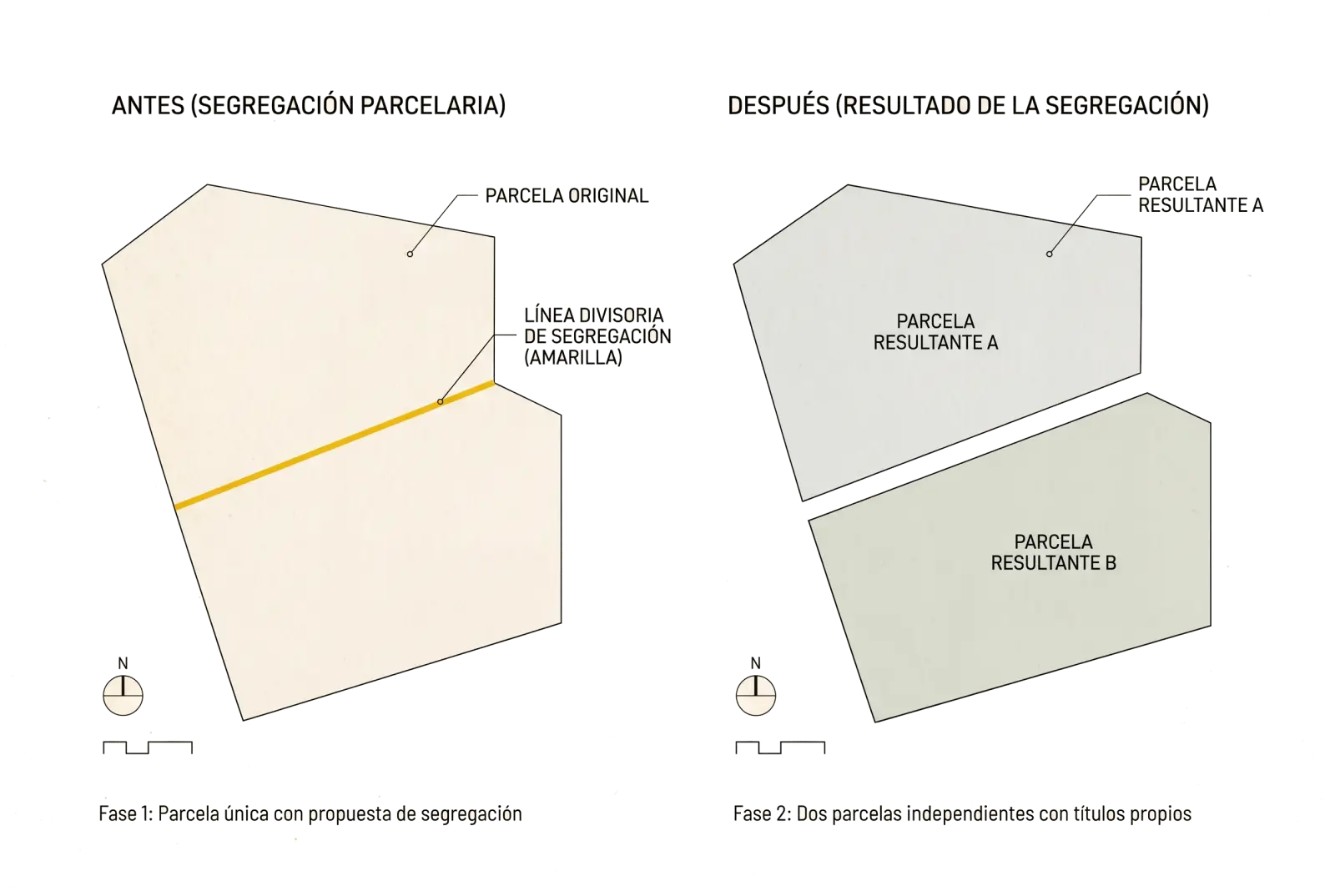
Segregation means separating part of a property so that it becomes a separate one, with its own entry at the Land Registry. Merging is the opposite: bringing several properties together into one. They are two distinct commissions pointing in opposite directions, but they travel the same administrative road, which is why they are explained together.
The underlying reason makes no difference — an inheritance to be shared out, the sale of part of a plot, buying the land next door. What decides whether it can be done is not the reason but the property itself.
Four names for two operations
The terminology causes confusion, and it is worth getting straight before asking for anything, because the document filed is not the same in each case:
- Segregation: a small portion is separated off and the original property survives, smaller than before.
- Division: the property is split into comparable parts and ceases to exist as such.
- Merger (agrupación): several properties are joined and a new property comes into being. None of the originals survives, and the resulting one inherits no cadastral reference.
- Absorption (agregación): one clearly larger property absorbs smaller ones and keeps its identity and its cadastral reference. It is still the same property, only bigger.
So who decides whether yours is a merger or an absorption? It is not a matter of judgement: an arithmetic rule in article 48 of the Mortgage Regulations settles it — the fifth rule. If the sum of the smaller properties does not exceed a fifth of the larger one, it is an absorption; if it does, a merger. A property of 10,000 m² absorbing one of 1,500 m² is an absorption, because 1,500 fits inside 2,000. Had the second one measured 2,500 m², it would be a merger. We explain it with more examples on our cadastral mapping site.
First, whether the property can be divided at all
Before drawing anything we obtain the planning report and check what the plan allows on that plot. The minimum plot size is neither a national nor a regional figure: each municipality sets it in its own general plan or subsidiary rules, and that is where it has to be checked, town by town. This is the same first step as in a building legalisation, and for the same reason: the rule that governs is always the local one.
On rural land there is a second rule, and it is the one that catches people out
If the property is rural, meeting the planning rules is not enough. A further rule applies, agricultural rather than planning law, and many people find out about it too late: the minimum cultivation unit, the area below which a property is no longer considered viable to farm. In the Valencian Community, Decree 217/1999 sets it at 2.5 hectares of dry farmland and 0.5 of irrigated land.
What is at stake is not one more formality. Article 24.2 of Law 19/1995 declares void any division leaving plots below the minimum unit, with no effect between the parties or against third parties, and paragraph 3 extends that to inheritance divisions, even against what the testator laid down. The exceptions are in article 25 and they are a closed list: transferring to an adjoining owner where both properties stay above the minimum, dividing off a plot for non-agricultural building with its licence, the right of access to ownership under rural tenancy law, and compulsory purchase. But exceptions is what they are, and it is the agricultural authority that assesses them.
Hence the most expensive mistake in this whole field: assuming the town hall's licence settles everything. It does not. Agricultural matters are a regional competence, and the town hall has no say in them. There are recent rulings on properties in this province that prove the point; one of them in Benissa: three plots of around 10,000 m², a hectare each, were divided off a property of 46,831 m², and the Land Registry suspended registration, because on dry farmland the minimum unit is 2.5 hectares.
And there is a third limit crossing the other two, this one from planning law: building an isolated family home on ordinary rural land requires a minimum plot of one hectare per dwelling, the building may not occupy more than 2% of the property, and the operation may not create a new settlement. Three different figures for three different things, and meeting one is no help if another is breached. Which is why no rural division is ever answered over the phone.
That hectare also explains why the commission is often the other way round. If you own several rural plots and none of them reaches the minimum area on its own, merging them can be the way to be able to build: what one plot does not give you, the sum does. It is the commonest reason for merging, and it is worth checking before buying the land next door, not after.
Licence, or a declaration that none is needed
Any parcelling, segregation or division producing two or more lots requires a municipal licence, unless the town hall declares it unnecessary. That declaration is not a shortcut: it is reserved for defined cases — divisions arising from land reparcelling, compulsory purchase, public works or a transfer to the authorities, and operations that do not increase the number of existing properties. On rural land the licence is required all the same, whatever the purpose.
Two figures worth having in front of you: the decision period is two months and silence counts as refusal. If the town hall does not reply, the licence is deemed denied, not granted.
What we deliver, and the route it takes
We draw up the full project — supporting report, drawings and georeferencing — together with the cadastral plot validation report, which in these operations is not optional: mortgage law requires georeferenced graphic representation precisely for segregation, division, merger and absorption. A positive report also confirms that the resulting property neither overlaps nor leaves gaps with its neighbours, which is what the registrar looks at.
All you provide are the title deeds and any related paperwork you have. The route from there has five stages, and they are worth seeing in order:
- Project. We draw it up, with a topographic survey and UTM ETRS89 coordinates.
- Licence. We file it with the town hall ourselves.
- Notary. The deed of segregation or merger is executed.
- Land Registry. The resulting properties are registered, each with its own entry.
- Cadastre. Last to hear, by way of the Land Registry, and that is where everything ends up aligned.
The project takes us three weeks. From there the calendar stops being ours: the town hall has its two months to decide on the licence and each one manages them in its own way. We work in Altea, Alfaz del Pi, La Nucía, Polop, Calpe, Benissa, Moraira, Finestrat and Callosa d'en Sarrià, among others, and in a procedure resolved with the local rules open on the desk, knowing what each town hall asks for gets you further than any template.
What it is not
Two common confusions, and both are settled by asking what is actually being split:
- Splitting a building into two dwellings is not a plot division. That is a horizontal division: what is shared out is the building, and the plot remains a single property. A parcelling licence is only needed if the split carries the land with it.
- Correcting a wrong figure at the Cadastre is not a division either. If the area or boundaries on record do not match reality, there is nothing to split: there is something to put right, and that is a different procedure.
Frequently asked questions
How big does my plot have to be before I can divide it?
There is no single figure. On urban land the minimum plot size set by each municipality's own plan governs, which is why the first thing we do is obtain the planning report. On rural land a second rule applies, and it is agricultural rather than planning law: the minimum cultivation unit, which in the Valencian Community is 2.5 hectares of dry farmland and 0.5 of irrigated land. When both rules apply at once, the larger one wins.
Can I split a rural property between my children?
Only if each of them ends up with a plot above the minimum cultivation unit. The law is blunt and says so expressly for inheritance divisions too: a division leaving plots below the minimum is void, with no effect between the parties or against third parties. There are defined exceptions — among them dividing off a plot for non-agricultural building with a licence — but it is the regional agricultural authority that assesses them, not the town hall.
If the town hall grants the licence, is that it?
On urban land, yes. On rural land, no: the licence settles the planning side and does not touch the agricultural side, which is a regional competence. There are recent rulings on properties in this province, one of them in Benissa, where the division had its licence and the Land Registry still suspended registration because the resulting plots fell below the minimum cultivation unit.
Licence, or a declaration that no licence is needed?
Any division producing two or more lots needs a municipal licence, unless the town hall declares one unnecessary. That declaration is reserved for defined cases: divisions arising from land reparcelling, compulsory purchase or a transfer to the authorities, and operations that do not increase the number of existing properties. The decision takes two months and silence counts as refusal — if they do not reply, the licence is deemed denied.
Is splitting my house into two flats a plot division?
No. That is a horizontal division and follows a different route: what is split is the building, not the land. The plot remains a single property. It only becomes a division if the split also carries the land with it, and then this procedure is required.