Building evaluation report and the old ITE
The report a building must hold once it turns fifty: inspection, drafting and registration, all in one commission.
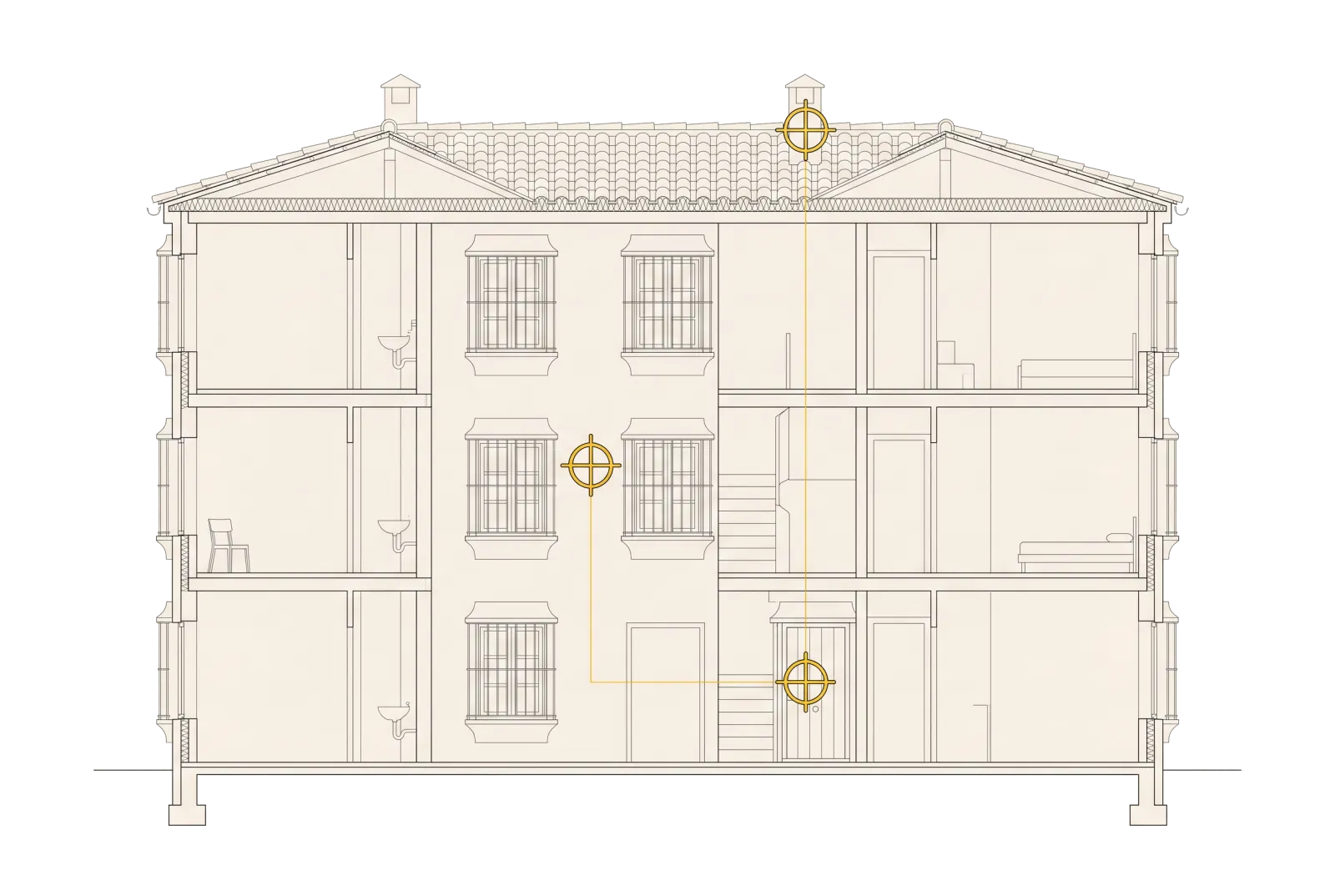
A building turns fifty and, from then on, it has to be able to show what condition it is in. That is the building evaluation report — the IEEV.CV in the Valencian Community: a dated diagnosis, drawn up by a technician after inspecting the building, entered in a regional register the town hall can consult.
It is not an exam that is passed or failed, and that is worth saying at the outset because it is the first question we are asked. It is a picture of the building on three fronts: how well it is maintained, what accessibility it offers and how it performs in energy terms.
Who has to have one, and by when
It is set by Decree 53/2018 of the Valencian government, the rule that governs it here. Two cases:
- The residential building is over fifty years old. The construction date is the one on the cadastral record, unless another is documented.
- You want to apply for public refurbishment grants, in which case the age of the building is irrelevant.
And there is a date almost nobody knows, because it appears in the decree rather than in the council's letter: the report must be filed and registered by 31 December of the year following the one in which the building turns fifty. The duty does not begin when somebody demands it; it begins on its own, with the calendar.
The duty — and the cost — falls on the owners; in a building held in commonhold, on the community of owners. And it is not only a matter for blocks of flats: a detached house over fifty years old is just as covered. The register has two sections, one for apartment buildings and one for houses, precisely for that reason.
The only exemption is a building for which formal dereliction proceedings have been opened — and if dereliction is refused, there are two months from that notification to have the report done and registered.
What is looked at, and how
The inspection is visual and follows an official guide, the same one for every technician working in the Valencian Community. Whatever is needed gets walked — common areas, flats and commercial units — and three things are assessed:
- State of conservation: structure, roof, façades, shared services; the constructional, functional, safety or habitability defects found, and what ought to be done about them.
- Accessibility: the condition the building is in and what reasonable adjustments could be considered.
- Energy performance of the building, which is what the old technical inspection did not cover.
Where what can be seen is not enough to judge a defect, the report says so: it records that a deeper study is advisable to establish cause and extent. That is honest and it is what the rule requires — a report that over-diagnoses from a visual inspection is worth nothing.
And if an imminent risk turns up during the visit, the technician must report it without delay to the owners and to the town hall so that safety measures can be taken. There is no discretion about it.
There is no “pass” and no “fail”
This is the part that reassures people once it is explained properly. The report is not approved or refused: it describes. What it can do is flag urgent works, and that sets off a chain of notifications worth knowing about beforehand:
- The report is filed and registered with the regional government.
- The regional government passes it to the town hall, which has access to the reports for its municipality.
- The town hall notifies the owner and the drafting technician so the necessary works are carried out, and sets the deadline in that notice.
Put plainly: the council finds out by design, not by chance. And what comes next is no longer this procedure — it is building work with its own consent: a responsible declaration or a licence, depending on what has to be touched. We handle that too, so the building does not have to find a new technician halfway through.
Access, which is what sets the calendar
In a house this is a non-issue. In a building with many flats it is the real bottleneck: the common areas and whichever flats are needed have to be entered, and that means time slots, keys and neighbours who work.
The rule is on our side — it requires owners to give access, including through privately owned parts, under the commonhold act — but a duty does not open doors by itself. In practice the one who makes it work is the managing agent: give us access floor by floor or day by day and the report moves quickly; otherwise it takes as long as the building takes to open.
Timescales and where we work
Ours, which are the ones that depend on us: a detached house we have done in around ten days. An apartment building depends on access — if it is granted a few days at a time, the calendar stretches and nobody is at fault.
Two more come from the rule and are worth noting: no more than three months may pass between the inspection and the electronic filing, and once registered the report is valid for ten years from the filing date. One detail that causes grief: the duty is only met from the moment registration is applied for, not from the moment the report is signed.
We work from Altea, and cover Alfaz del Pi, La Nucía, Polop, Calpe, Benissa, Moraira, Finestrat and Callosa d'en Sarrià, among others.
If what you want is someone to look at your house
Then this is probably not it, and we would rather say so. The IEE is compulsory, covers the whole building and goes on a public register. Someone calling before a purchase, or because a crack has appeared, almost always needs something else:
- An architect's visit, with or without a written report, depending on what you need it for.
- An architect's consultation, if talking it through settles the question.
- An expert appraisal, where there is damage to argue over with an insurer or a third party.
They are five different things and the difference is not always visible from outside, so the first call is for exactly that: telling you which one fits. An IEE for someone who does not need one is money wasted, and the reverse — a visit for someone with a duty outstanding — leaves the problem where it was.
The ITE, and what you will read elsewhere
If your building already holds a valid technical inspection, it is not thrown away: it is validated as an IEEV.CV provided the energy assessment is added, and it stands for as long as that ITE runs. When renewal falls due, the full report applies.
One warning, because much of the internet has it backwards: the building evaluation report does appear in a national act, but the provisions that governed it were struck down by the Constitutional Court in 2017 for encroaching on regional powers. What binds here, with its deadlines and its register, is the Valencian decree — dated April 2018, four months after that judgment. So rules you find on national websites need not match what your town hall will ask for.
The commission, step by step
- Check whether the building is covered and how long there is, with the cadastral date in front of us.
- Arrange access with you or with the managing agent: what gets visited, and when.
- The visual inspection of the building, to its official guide.
- Draft the report in the official software and file it electronically: the register returns the file number and notifies the town hall as well.
- Hand it over explained, with what needs doing and in what order, ready to go into the building's logbook.
Here the drafting and the registration come in the same commission: the report is filed under the responsible declaration of the very technician who signs it, so separating them would mean nothing.
Frequently asked questions
When do I need one?
Once a residential building is more than fifty years old, counted from the construction date on the cadastral record unless another date is documented. And the decree sets a deadline almost nobody knows: it must be filed and registered by 31 December of the year following the one in which the building turns fifty. You also need one, whatever the building's age, to apply for public refurbishment grants.
How often does it have to be renewed?
The IEEV.CV is valid for ten years from the date of electronic filing, and a new one must be filed before that runs out. Note when the clock starts: not the day of the inspection, not the day the report is signed — the day it is registered.
Are the IEE and the ITE the same thing?
In the Valencian Community they are a single procedure. The IEEV.CV covers what the old technical inspection assessed — conservation and safety — and adds universal accessibility and energy performance. If your building holds a valid ITE, it is validated as an IEEV.CV provided the energy assessment is added, and only for as long as that ITE runs. When it falls due for renewal, the full report applies.
What if it is a detached house?
The obligation is the same. The regional register has two sections, one for apartment buildings and one for single-family houses, precisely because both are covered. A villa over fifty years old carries the same duty as a block of flats, and it is usually its owner who has no idea.
What happens if I do not do it?
The council can require you to file it within two months. If that passes without compliance, it may act in your place: commission the report itself at the expense of whoever owed the duty, and apply whatever penalties the planning legislation provides. The decree also states plainly that not holding the report when required is a planning infringement.
A neighbour will not let us into their flat. Can they refuse?
No. The decree requires owners to give the technician access to every area needed for the assessment, including through privately owned parts, in accordance with the commonhold act. The logistics are another matter: in a building with many flats, visits and time slots have to be arranged, and that is usually the managing agent's job.