Building licence for major works
The project for work that does need a licence — building, extending, touching a protected façade — and, if you want it, the filing.
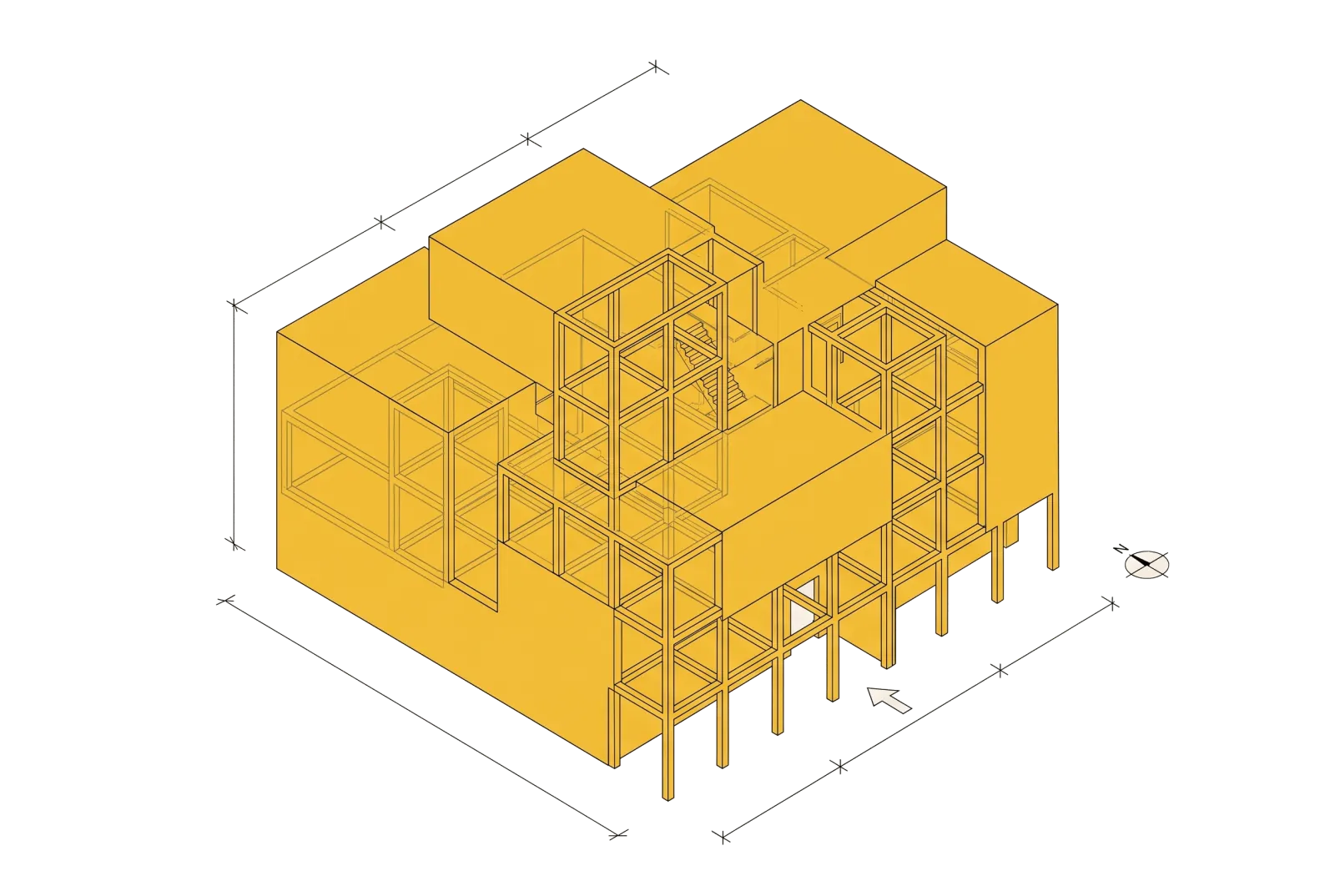
Almost nobody arrives asking for a licence. They arrive asking for “a few drawings” to take to the town hall — and quite often what the job needs is a full project, stamped and with an architect running the site. This page is here to tell you which side of the line your work falls on, before you commission anything.
Start with something that surprises most people: obra mayor and obra menor — major and minor works — are not categories of Valencian law. They are counter vocabulary, which is exactly why builders and neighbours use them. What the law draws is a different line. The TRLOTUP, the regional planning act, separates acts subject to a licence under article 232 from those subject to a responsible declaration under article 233. That line decides the paperwork, the timescale and, above all, when you may start.
Which works need a licence
Article 232 lists them. These are the ones that turn up in a private commission:
- New build: a new house, an extension that creates volume, a pool with a structure of its own.
- Work on protected or listed buildings where it carries heritage significance. The nuance decides many cases in the old town of Altea: it is not enough that the building is listed — what counts is whether the work touches what is protected. Replacing interior services is not the same as touching the façade.
- Earthworks, levelling and plot divisions — dividing or merging plots has its own page.
- Temporary works and uses, and siting prefabricated houses, which many owners assume are unregulated and are not.
Then there is a middle group, and it causes most of the confusion: structural alterations, demolitions and changes of use go, in law, by responsible declaration — but one that must carry a certification, with the same project and the same technical demands behind it. In practice every council has its own counter and its own forms: Altea's building licence procedure, for instance, covers new build, structural alterations, changes of use and temporary works. So the first thing we do is check which route your work actually takes in your municipality, rather than assume the name of the procedure.
What has to be filed
What we draft and sign:
- The technical project under the Spanish building code, with full drawings. The college visado is not a counter-clerk custom here: Royal Decree 1000/2010 makes it compulsory for the construction project and for the final works certificate, whatever the council asks for. The outline project falls outside that national list, but several councils require it anyway —Altea among them— so here it gets stamped as well.
- The construction and demolition waste management study.
- A photographic survey of the plot and of what is there, the building statistics form and the georeferenced topographic plan.
What we need from you:
- The deed or a land registry extract, and the details of the owner and the property.
- The other parties to the works, once you have chosen them.
- Proof of payment of the council fee and of ICIO, the tax on construction, installations and works, both settled on filing.
Everything goes in through the council's electronic register. What we always do is draw up and sign the technical documents; filing them and running the application on behalf of the owner or developer is something we can do too, as a separate commission — some owners prefer to file themselves once the papers are done. Depending on where the plot sits, further documents may be required — and that is where an application really stretches.
Sector consents, which are what stretch the calendar
This is the chapter nobody has in mind at the start, and it does not depend on the town hall: depending on the location, the work may need the consent of another authority, and until it arrives there is no licence.
- Regional: roads, railways, coasts, agriculture, forestry.
- National: roads, railways and the river basin authority — a dry watercourse near the plot is reason enough.
- Cultural heritage and archaeology, routine in the old town.
- Telecommunications.
- Occupation of the public highway for the skip or the scaffolding, and works in the highway itself if drains or paving are involved. These are separate procedures, handled by a different municipal department.
Timescales, silence and where we work
The timescales worth putting in writing are the ones the law fixes. Article 240 gives the council two months to decide a licence for a new build, an equivalent structural rebuild or a demolition on an unlisted building, and three months where the building is listed or in the process of being listed.
And there is a rule worth knowing before you rely on it: on a building licence, silence means refusal. If the deadline passes with no decision notified, the application is deemed refused; only a closed list of cases — structural alterations, changes of use, boundary walls, signage — is deemed granted. That is article 242, as rewritten by Law 3/2026 of 29 June, in force since 3 July 2026. Put plainly: nobody starts building because no one said no.
How long each council actually takes is outside anyone's control here, so we do not promise it: every town hall is a world of its own. We work from Altea, and cover Alfaz del Pi, La Nucía, Polop, Calpe, Benissa, Moraira, Finestrat and Callosa d'en Sarrià, among others. In a procedure resolved council by council, knowing the people across the counter is worth as much as knowing the rule.
When the work changes along the way
It happens more often than you would think, in two ways. The owner wants to change the project once work has started, or opening up reveals what nobody could see — a foundation problem, a floor structure that was not what the drawing said. Either way the work no longer matches the licence granted, and carrying on means building without title: the job has to stop while the paperwork is redone with an amended project.
That is not merely an extra formality; it is site time lost. So when we review a project before filing, it may happen that we spot something better resolved on paper than on site; when it does, we say so. That does not make the commission a structural survey of the property: if what you want is someone to look at what is there before deciding, that is an architect's visit, and it is commissioned separately.
If the work is already built
Then the question is no longer “will they grant a licence?” but “can this be legalised?”, and they are not the same. A licence authorises what is going to be built; legalisation puts right what already stands, and it starts by checking whether what was built fits what the planning rules allow on that plot. Sometimes it fits, sometimes it fits in part — and legalising then means demolishing the excess — and sometimes it does not fit at all.
It is a slower, less certain and more expensive road than applying first, and it tends to arrive uninvited: on the day the second occupancy certificate is applied for, to sell or to let, and the council compares the drawings against the deed.
If your work does not go that far
Plenty of work needs no licence at all. Changing the internal layout, working on the façade, refitting a bathroom or replacing windows go by responsible declaration — what everyone still calls minor works — and the procedure is a different animal: filed with its technical report, and you may start the same day. That page explains how it works and, more to the point, when work that looked minor stops being minor.
The commission, step by step
- Establish which side your work falls on, in your municipality: licence, responsible declaration with certification, or neither.
- Check what the plot allows before drawing anything, with a planning report where one is needed.
- Draft the project, have it stamped and assemble the conditional documents.
- Hand the documents over, explained and ready to file.
And if you want it, the next two steps are ours as well — commissioned separately, and they are the ones that save the back and forth:
- File through the electronic register on your behalf and run the application: requests to put things right are answered from here.
- Hand over the licence, explained: what exactly it authorises, on what conditions, and the deadlines to start and to finish that it carries inside.
Frequently asked questions
Do I need a full project, or will drawings do?
It depends on the work, not on the budget. If what you are doing is subject to a licence — a new build, an extension, an intervention with heritage significance on a protected building — a full technical project under the Spanish building code is required, together with a site architect. Dimensioned drawings are fine to discuss an idea; they are not what you file. What we can do is look at your case before you commission anything and tell you which route it takes.
How long does it take, and what if the council never answers?
Article 240 of the TRLOTUP gives the council two months to decide a licence for a new build, an equivalent structural rebuild or a demolition, and three months where the building is listed or in the process of being listed. How long each town hall actually takes is not something we control, so we do not promise it. What matters more is what happens when the deadline passes: on a building licence, silence means refusal. That is article 242, as rewritten by Law 3/2026 of 29 June, in force since 3 July 2026.
What is the visado, and is it always required?
The visado is the stamp the professional college puts on the project, certifying that whoever signs it is a qualified architect in good standing. On building work it is neither optional nor the council’s call: Royal Decree 1000/2010 makes it compulsory for the construction project, for the final works certificate and for both where they are filed in a legalisation procedure, whatever the council asks for. The outline project falls outside that national list, but that does not mean it travels unstamped: some councils require it all the same, and Altea is one of them. So around here the practical answer to «is it always required?» is yes. It is not the same thing as an ECUV, which is a private body authorised to carry out administrative functions within the procedure.
Can I start work as soon as I file the application?
Not on a licence: you wait until it is granted. That is precisely the difference with work that goes by responsible declaration, where you may start the same day it is filed complete. Starting earlier turns a lawful project into unlicensed building work, with everything that drags behind it.
I have already built without a licence. Can I apply now?
Then it is not a licence application, it is a legalisation, and the first question changes: not what you want to build, but whether what is already there fits what the planning rules allow on that plot. We have a separate page for that. If the work is half done and has drifted from the project, the right move is to stop and put it right before carrying on.
What is an ECUV, and should I use one?
A private body authorised to act for the planning administration — verifying projects and issuing certifications within the procedure, under the fourth additional provision of the TRLOTUP. It exists as a route and some owners use it to speed things up. We do not usually work with them, and it is worth knowing that the requirements are identical; what changes is who reviews them. A professional college can only perform those functions if it has itself been set up as an ECUV.