Urban planning reports and certificates
What the local plan allows on one specific plot — and the documents the council issues to prove it.
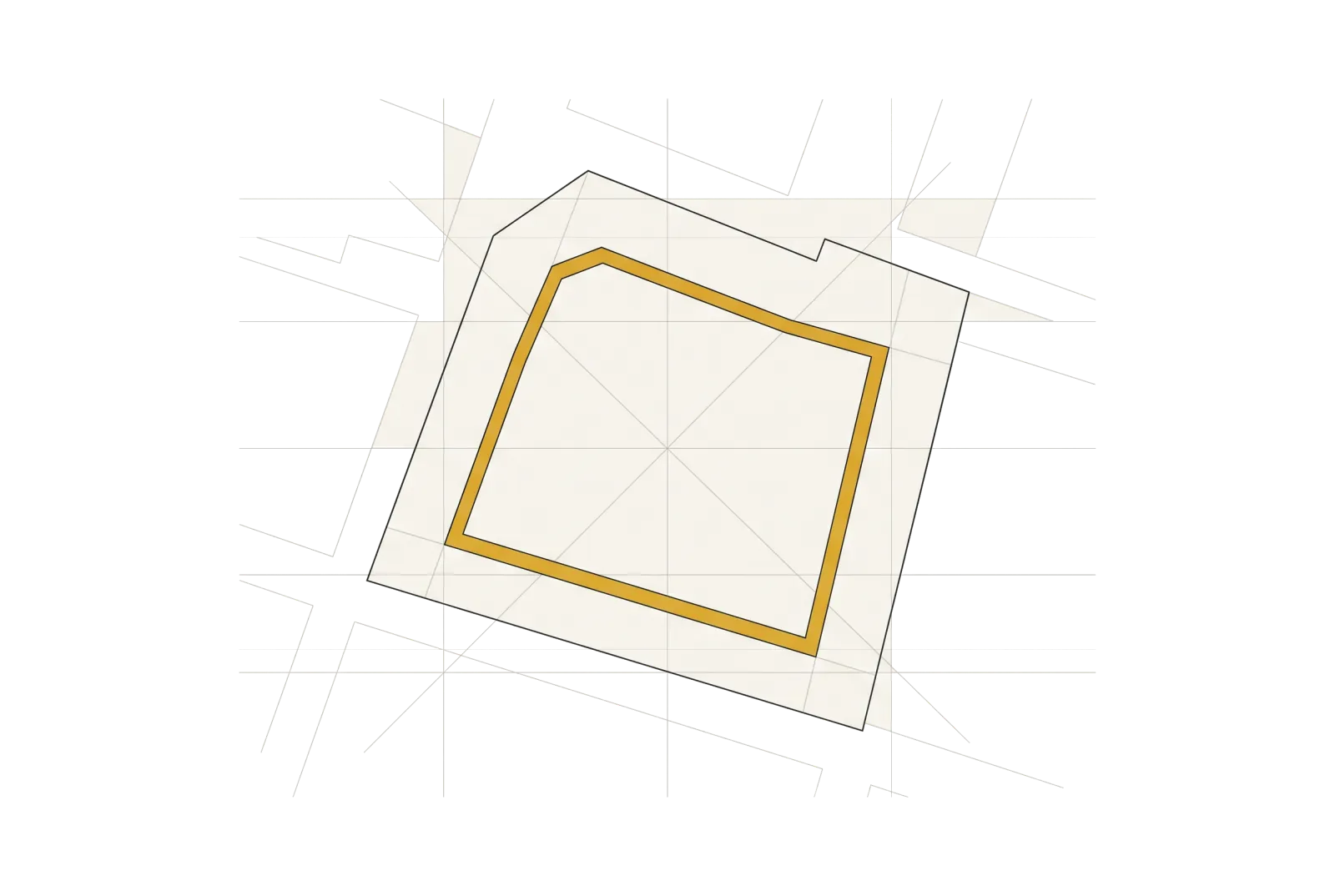
Can I build on this plot? It is the first question almost everyone arrives with, and the answer is not in the title deed or in the cadastre — those describe what is already there. It is in the municipal plan and the ordinances that develop it, and the council will put it in writing when asked.
Four different documents travel under the loose heading of “planning report”, each answering a different question. We request them, chase them and, above all, read them back to you in plain terms:
- the planning report — what may be built;
- the planning compatibility certificate — whether an activity is allowed at that address;
- the no-infringement certificate — whether any enforcement file is open;
- and the council archive — old licences and drawings, recovered.
What can be built on a plot
The law protects this question. Article 246.4 of the TRLOTUP, the Valencian planning act, obliges councils to inform anyone in writing, within one month, of the classification, zoning and development status of a piece of land. The reply covers permitted uses, buildable floor area, heights, setbacks and maximum footprint — the figures a project has to be designed around.
There is also a stronger instrument, and it is the one to know about before buying: the cédula de garantía urbanística, a planning guarantee certificate. The same article obliges the council to issue it, again within one month, for plots capable of being built on; it states the zoning and classification and is valid for one year. During that year, if the conditions it states cease to hold, the council is liable for the loss caused by the change in planning. It is not a permit and it does not replace a licence, but it is as close to a written commitment about today's rules as Spanish planning law offers.
What the job does not include is worth saying up front: this is reading the plan, not designing a building and not inspecting the ground. Something may well surface in the reading that changes the idea you came with — an alignment, an easement, a use that does not fit — and when it does we say so; but working out what is actually worth building there is a consultation, and seeing the property itself is a visit.
Compatibility: the gateway for any activity
A buildable plot does not mean any use goes on it. To open a business, or to let a home to holiday guests, what has to be established is that that specific use fits the zone — and that is a separate document, the planning compatibility certificate.
For holiday lets it is a condition of entry. Article 65.1 of Law 15/2018 requires a favourable municipal planning compatibility report for tourist use, the property's own individual cadastral reference and whatever municipal permits apply, before it can be a vivienda de uso turístico. That is why the procedure always starts here: an unfavourable report ends it, and a favourable one is issued with a CSV code that the later declaration relies on.
The answer depends on the municipality and, increasingly, on the street. The law lets councils cap the number of tourist homes per building, sector or zone through their planning, on published and objective criteria. Altea was among the first to act: it suspended new compatibility reports in January 2024, having granted more than 2,200, and since this summer it has an ordinance that grades urban land zone by zone according to residential pressure, with different limits in each. Finding out which zone a property falls in comes before anything else, and the municipal geoportal is where that starts.
The no-infringement certificate, and what it does not say
It certifies that no enforcement file has been opened on a property. Buyers ask for it, and it is useful — but what it states is the absence of proceedings, not lawfulness. Anyone who needs proof that a home meets the conditions has far better evidence in the second occupancy certificate, which checks what was built against what was authorised.
The distinction matters because time is misleading here. Article 255 gives the administration fifteen years from completion of the works to order the restoration of lawful use, which is where the widespread belief comes from that an old building is safe. It has two large holes in it:
- The clock does not always run. It does not apply to works on green space, roads, open space or public facilities, on public-domain land or on assets listed in the Valencian cultural heritage inventory, nor on rural land — and a good share of the older, paperless houses inland from the coast sit precisely there. On those, no time limit ever expires.
- Running out the clock legalises nothing. Article 256 is blunt about it: while the breach persists, no alteration, extension or consolidation of the unlawful work may be carried out.
Where unlicensed work turns up, the way through is legalising it, not waiting it out.
The licence and drawings still sitting in the council archive
This is the one almost nobody advertises, and it solves a problem most people write off: the paperwork for your house exists even if you do not have it. The building licence from the seventies, the project filed with it and its drawings are, in most cases, still in the municipal archive. They can be consulted and copied.
From those the legal history of the property can be rebuilt — which is what is needed to certify its age, to compare what was authorised against what stands today, to prepare a legalisation, or to explain why the deed and the cadastre disagree.
Before you buy
Nearly all of the above can be asked before signing, and that is when it is worth most. Afterwards the answers are exactly the same — only the property is already yours:
- what the plan allows, and how much of it;
- whether the use you have in mind fits the zone;
- whether any enforcement file is open;
- whether what stands there matches what was authorised;
- and whether the plot can be divided, when that is the plan.
If the doubt is instead about where the boundaries run or how large the plot really is, that is settled by a graphic validation, not by the planning rules.
How it is requested
We need the cadastral reference, the title deed or a nota simple, your identification and a signed authorisation. We draft the query — half the work, since a badly framed question comes back answered with a useless paragraph — file it through the relevant council's electronic office and follow it until the reply lands. Nothing has to be done in person.
Timescales
The law sets its own: one month to reply in writing, and one month to issue the planning guarantee certificate, which is then valid for a year. How long a particular council actually takes is another matter and not ours to promise — some answer promptly, others take considerably longer. We work from Altea, and cover Alfaz del Pi, La Nucía, Polop, Calpe, Benissa, Moraira, Finestrat and Callosa d'en Sarrià, among others.
Frequently asked questions
Can I build on a plot I am about to buy?
That is exactly what a planning report answers, and it is worth asking before you sign rather than after. The council is obliged to reply in writing within one month about the classification and zoning of a piece of land, and the reply sets out what may be built there: permitted uses, buildable floor area, heights, setbacks and maximum footprint. A plot advertised as buildable is not always buildable, and the local plan is the only place where that is settled.
What is the difference between a planning report and a compatibility certificate?
A planning report answers what can be built on a plot. A compatibility certificate answers something else — whether a particular activity is allowed at that address — and it is the one you need to open a business or to let a home to holiday guests. Same council, similar-looking documents, different questions.
Do I need one for a tourist rental?
Yes, and it is the first step. Article 65.1 of Law 15/2018 requires a favourable municipal planning compatibility report for tourist use before a property can be registered as a vivienda de uso turístico. If it comes back unfavourable there is nothing further to file, so starting here saves preparing an application that could never be submitted. The favourable report carries a CSV code, which is what the later declaration refers to.
Does a no-infringement certificate prove the house is legal?
No, and the confusion is an expensive one. It states that no enforcement file has been opened, which is the absence of proceedings, not lawfulness. If what you need is proof that a home meets the conditions to be lived in, the second occupancy certificate is far stronger evidence. And time alone legalises nothing: article 256 of the TRLOTUP says so outright.
Can you find the licence and plans for an old house?
Usually, yes. Building licences and the projects filed with them are kept in the council archive, where they can be consulted and copied. It is how the paperwork for a house built in the sixties or seventies gets recovered, often with drawings nobody remembered existed.
What do you need from me to start?
The cadastral reference of the property or plot, the title deed or a nota simple, your identification and a signed authorisation to act on your behalf. Everything is filed through the council's electronic office, so there is no counter to visit and no appointment to book.