Plot survey before you buy
What has to be checked on a plot before you pay for it: planning rules, restrictions, utilities and what building on that ground is going to cost. In two or three days.
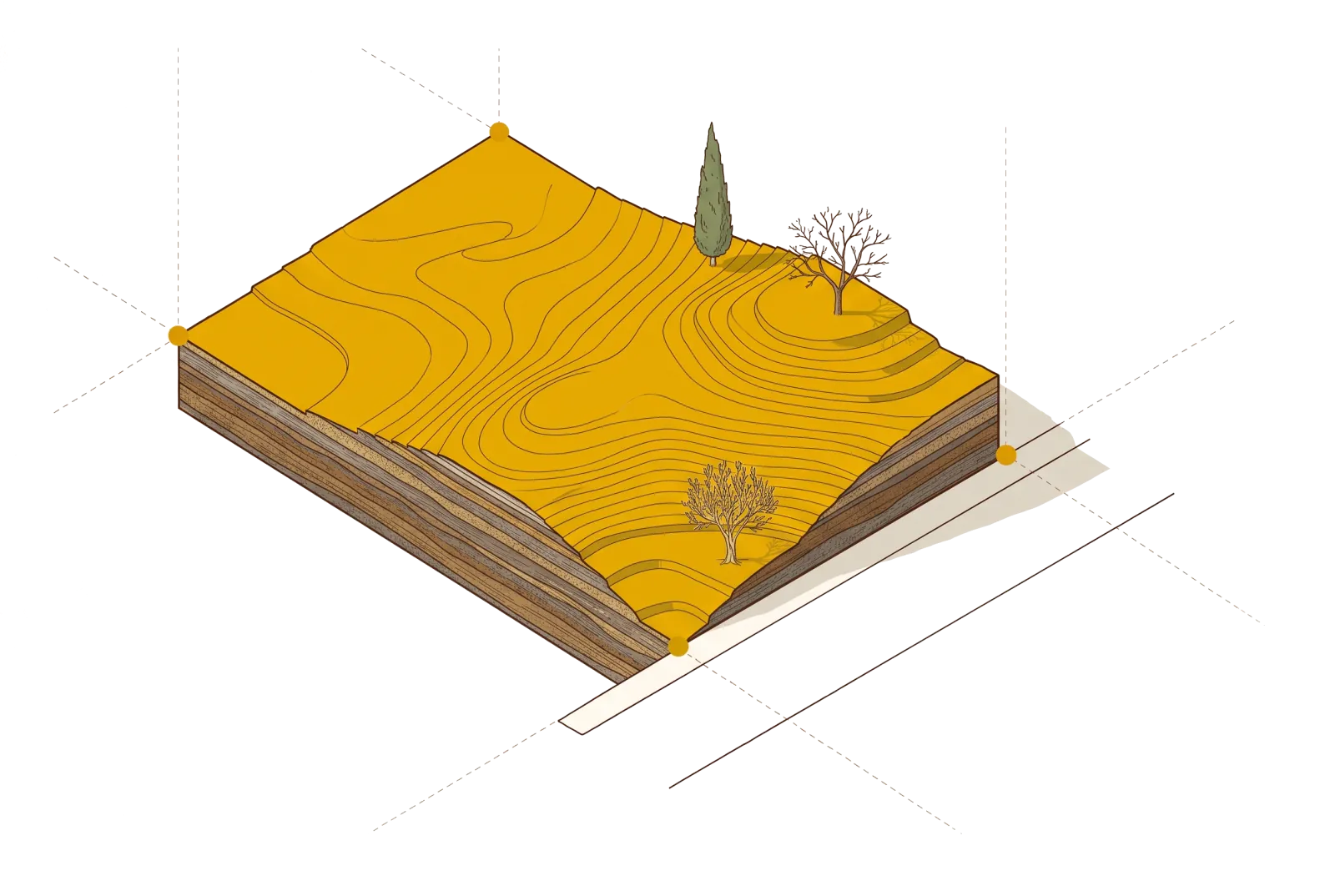
Before buying a plot you need to know three things: what can be built on it, what affects it, and what building on that ground is going to cost before the first brick is laid. The listing tells you none of the three. The plot survey answers them in two or three days, so that you decide on facts and before someone else buys it.
Many clients ask us for it, and above all those coming from abroad: buying land in a country with different rules, without knowing the terrain and sometimes without having set foot on it, is where a mistake costs most. And we say it every time: cheap plots are not to be trusted.
What we check
- The municipal planning rules. What the plan allows on that plot: buildable area, site coverage, heights, setbacks, uses. It is what the council's planning report confirms later; we read it in the plan before it arrives.
- Sector restrictions, on the plot. We go and see it. What affects it from outside — roads, watercourses, power lines, railways, coastal and forestry rules — is easier to see on the ground than on a plan.
- Utilities and urbanisation. Whether water, electricity, sewerage and access reach the plot, and whether it really counts as a serviced building plot. Urban land that has not been urbanised cannot be built on until someone pays for the urbanisation, and that someone is usually the buyer.
- What building on that ground is going to cost. Relief, topography and geology: the slope that demands retaining walls and special foundations, the soil that is not what it looks like. It is the part most often forgotten and the one that takes most of the budget, and it is signed by a civil engineer, who knows about ground.
- The documents. Land Registry extract, deeds, cadastre: that what is being sold is what the paper says, with its area, its charges and its boundaries.
What the planning report does not say
The council's report is essential, and we request it together with the survey. But it is a document about parameters, not about the land: it may not mention the high-voltage line crossing the corner, the ravine that imposes a larger setback than the rule, or the railway fifty metres away. Those restrictions exist all the same, they are managed by other authorities, and they condition what can be built as much as the buildable area does. That is why we go to the plot.
What building on that ground costs
Two plots with the same buildable area can cost very differently to build on. A steep slope turns into retaining walls, into a foundation that is no longer the simple one and into earthworks that were in no budget. Poor ground, into more of the same. The survey does not replace the geotechnical study, which is commissioned once there is a project, but it does say in advance whether that plot will require one and how much the ground is going to weigh in the build.
When the council's report arrives
It arrives when it arrives: it is the administration's and its timing does not depend on us. What we do is not wait for it to work. The survey is delivered in two or three days; when the report arrives, we check what we said against what it says, and if something does not match, you know.
After the survey
If the plot works, the survey is the first piece of the project: what it says about orientation, slope and restrictions is exactly what the concept design of a new house needs to know before anything is drawn. If it does not work, you have spent two or three days instead of a plot.
And if what you have is a specific question rather than a plot to survey, the consultation with the architect is the place: by phone or at the office, without travel.
Where we work
From Altea, in Alfaz del Pi, La Nucía, Polop, Calpe, Benissa, Moraira, Finestrat and Callosa d'en Sarrià, among others. The survey includes a visit to the plot, so it is done wherever we can go and see it.
Frequently asked questions
How is this different from the council's planning report?
The planning report is issued by the council and states the plot's parameters: buildable area, site coverage, setbacks, heights. It is essential, we request it together with the survey and we use it to confirm. But it arrives when it arrives, and there are things it does not say: whether a high-voltage line, a watercourse or a railway affects the land, whether the plot really counts as a serviced building plot, what it will cost to found a house on that slope. The survey is the fieldwork and the analysis we do while the report is on its way, so that you do not have to wait for it to decide.
How long does it take?
Two or three days from the moment you give us the cadastral reference and whatever documents you have. It is our deadline and we keep it, because the point of the survey is that you decide before the plot is sold to someone else. The council's planning report arrives later, on its own schedule, and when it does we check what we said against what it says.
What do I receive?
A report with everything checked, point by point: planning rules and restrictions, what we saw on the plot, utilities and urbanisation, the costs the ground will add and what the documents say. And a clear conclusion: whether you can build what you want, under what conditions, and what is worth negotiating before you sign.
What if I already own the plot?
Then the survey is the start of the project rather than a step before buying. It serves the same purpose: it fixes what can be built and what building on that ground will cost before anything is drawn, which is exactly what the concept design needs to know. If you are commissioning the house from us, we do it as the first step of the commission.
Why be wary of a cheap plot?
Because the price usually tells you something the listing does not. A restriction that prevents building or cuts the buildable area, a slope that eats the budget in retaining walls and foundations, a plot that looks urban but is not a serviced building plot, ground that demands more than usual. None of that shows in the photo, and all of it shows in a survey. Cheap plots are not to be trusted until someone looks at why they are cheap.